.svg)

In the executive forums where AI leaders compare notes, the conversation has shifted. A year ago it was about what AI agents could do. Now it is about what happens after the enthusiasm wears off: the agent nobody owns, the instructions nobody versioned, the approval nobody can produce when an auditor asks, the experiment that leaks company IP onto the open internet.
The pattern behind those failures is consistent. The barrier to building a capable AI agent has collapsed. The barrier to trusting one has not. Closing that distance is what governance means in practice, and it rests on four pillars.
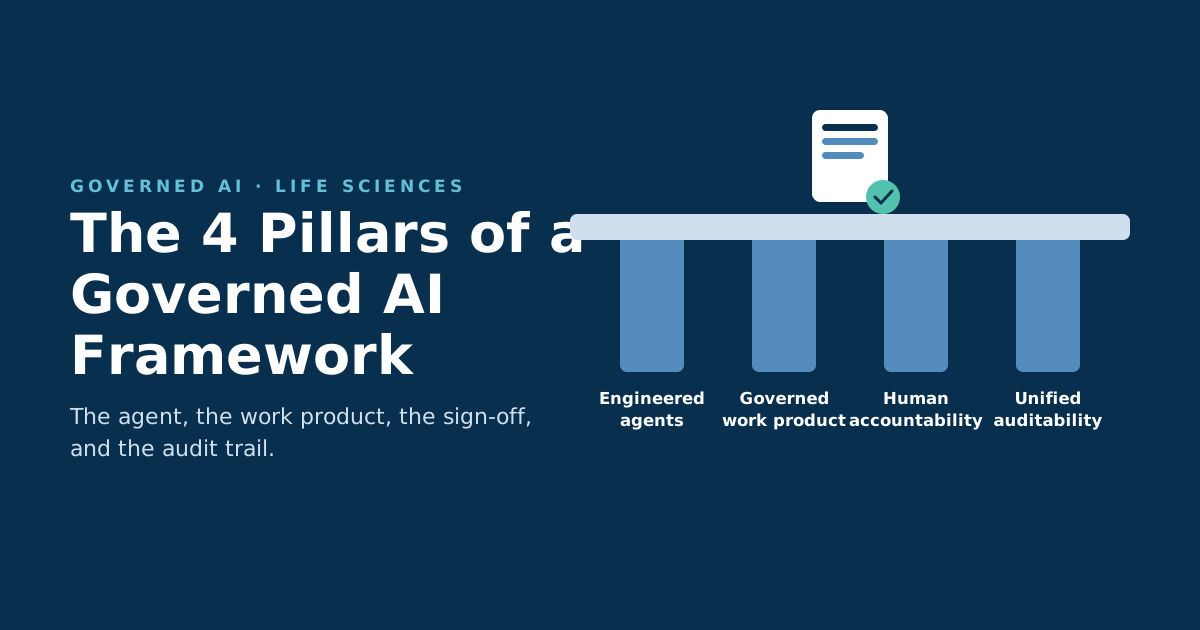
A governed AI framework stands on four pillars: engineered agents, a governed work product, enforced human accountability, and unified auditability. Three of the four map onto published guidance from NIST, the FDA, and the EMA. The second is the one those frameworks leave open, and it is where regulated AI programs most often come apart. The first pillar is delivered by a development discipline; at BP Logix we call it the Agent Development Life Cycle. The other three govern everything that happens around the work an agent touches. For life sciences teams, where that work may be a regulated submission, a safety review, or a plain language summary, the four pillars are the difference between an AI program you can defend and one you hope nobody examines too closely.
Breaking Down the Four Pillars
Here is what each pillar requires, and what to ask about your own program along the way.
Pillar 1: Engineered Agents
Can you prove the agent was tested before it shipped?
Dependable agents come from a repeatable discipline, the same way dependable software comes from a development life cycle. That discipline matters more now than it ever has, because the people building agents are often not engineers. They are product managers, analysts, medical writers, and ops leaders with deep domain expertise and enough access to stand something up in an afternoon.
That is remarkable, and for exploratory work it should be encouraged. When an agent’s output touches customers, physicians, regulators, or the press at volume, the agent has to be engineered for the job. FDA’s January 2025 draft guidance on AI in regulatory decision-making draws the same line with two factors. Model influence is “the contribution of the evidence derived from the AI model relative to other contributing evidence used to inform the question of interest.” Decision consequence is “the significance of an adverse outcome resulting from an incorrect decision concerning the question of interest.” An agent that scores high on both belongs inside the full discipline.
Without that discipline, you may not even know your in-house citation-checking agent was never tested against oncology research sources. The bill arrives later, when a manuscript cites an unrelated immunology study on psoriasis instead of melanoma and someone has to explain how.
Engineered means the practices that produce dependable software are applied to the agent before anyone trusts it in production. BP Logix formalizes this as the Agent Development Life Cycle (ADLC), which rests on five commitments:
-
A behavioral contract. Before an agent is built, its job, its boundaries, and its expected inputs and outputs are written down.
-
Golden datasets. A representative, human-reviewed set of example inputs and correct outputs becomes the yardstick. Part of it is held back and never used during development, so the final check measures real performance rather than memorized answers.
-
Eval-driven development. Each agent is graded against that yardstick and must meet or beat the human benchmark before it ships. Compliance-critical properties, factual accuracy and correct source attribution among them, act as hard gates.
-
Human checkpoints. People review and approve at defined points. Nothing high stakes proceeds on the agent’s say-so alone.
-
Full auditability. Every prompt, dataset, and evaluation result stays under version control.
The Agent Development Life Cycle
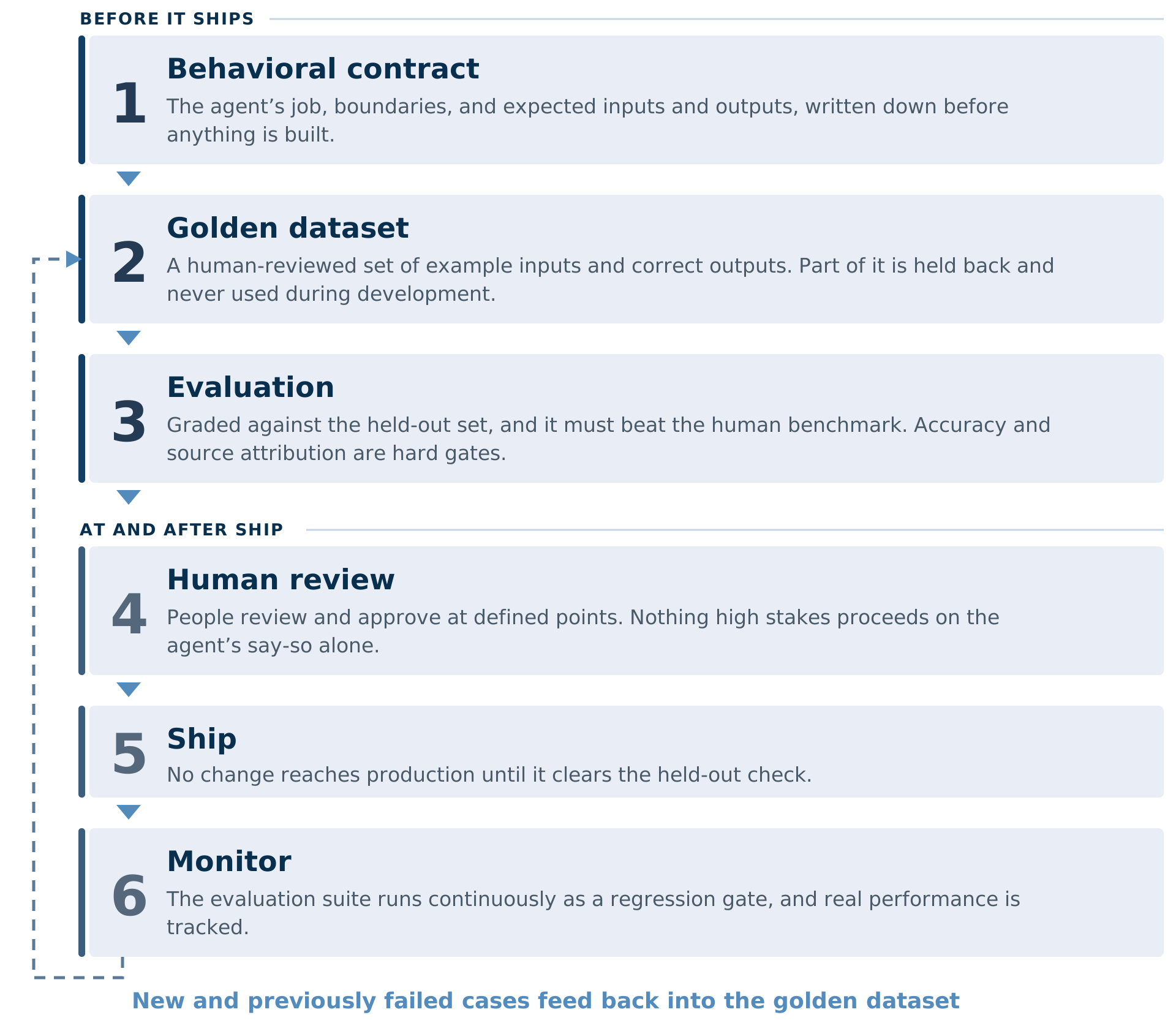
The commitments do not stop at launch. The joint FDA–EMA guiding principles, published in January 2026, expect AI technologies to “undergo scheduled monitoring and periodic re-evaluation to ensure adequate performance (e.g., to address data drift).” In the ADLC, the same evaluation suite that gates release runs continuously as a regression gate.
The ADLC is how the first pillar gets built. The remaining three pillars extend that discipline beyond the agent, to the work it produces and the people responsible for it.
The question to ask: can you prove this agent was tested against a wide body of known good examples before it shipped?
Pillar 2: A Governed Work Product
Can you show how the deliverable moved through the process?
Enterprise AI assistants have matured fast, and most ship with admin consoles, usage dashboards, and audit logs. Those controls govern the assistant. They do not govern the work, and that gap produces false confidence. An admin console tells you who logged in and what an agent touched. For most business functions, that is enough. For a regulated deliverable, it is nowhere close.
Even the newest AI security standard draws its boundary short of this pillar, on purpose. OWASP recently published version 1.0 of its AI Security Verification Standard, and its documentation says plainly what it is not: “Not a governance framework.” Business records, document approvals, and regulated submissions sit outside its scope by design. That boundary marks precisely where the second pillar begins.
Consider what regulated means in practice: a pharmaceutical company preparing a submission the FDA or EMA will scrutinize, a medical affairs team publishing plain language summaries to industry standards, a manufacturer operating under GxP. In those environments, the deliverable itself has to travel a governed path.
A governed work product means the platform knows what the deliverable is, where it sits in the process, which data is relevant at each step, who must review it, what an agent contributed, what changed afterward, and what evidence must be retained. It records the journey of the work alongside the behavior of the agents that touched it.
Regulators describe the same expectation from the other side. The FDA–EMA principles require that processing steps and analytical decisions be “documented in a detailed, traceable, and verifiable manner, in line with GxP requirements.” A record of what an agent did, kept apart from a record of what happened to the deliverable, does not meet that bar.
The question to ask: when a deliverable ships, can you show how it moved through the regulated process that produced it?
Pillar 3: Enforced Human Accountability
Is human sign-off guaranteed or optional?
Every enterprise assistant can prompt a user to approve a tool call. We have yet to find one that guarantees a person signs off on a deliverable at a defined checkpoint. Approval rests on individual habits rather than on a control the process enforces.
The automobile industry offers a humbling parallel here. The seat belt was a simple control, well understood long before it became standard equipment, and it still took decades to arrive. Enforced human sign-off is the seat belt of enterprise AI: everyone agrees it matters, and almost nobody has made it structural.
Enforced accountability means high-stakes work cannot advance without a named person approving it at a defined checkpoint. The process guarantees the review happens; it does not depend on someone remembering to look.
Two regulators have now said this directly. FDA’s draft guidance instructs that “If the COU [context of use] involves a ‘human in the loop,’ ensure that the evaluation methods consider the performance of the human-AI team, rather than just the performance of the model in isolation.” The FDA–EMA principles ask that performance assessments “evaluate the complete system including human-AI interactions.” An optional checkpoint means you are not evaluating the system anyone will actually run.
The question to ask: where is the human approval checkpoint, and is it guaranteed or merely optional?
Pillar 4: Unified Auditability
Could you produce the audit trail tomorrow?
You can audit the chats and agents. You can audit the data. In most organizations, no single trail connects them to the deliverable they produced. The document, the steps taken, and the model’s contribution live in separate systems, and stitching them together after the fact is somewhere between painful and impossible.
For regulated work, that gap decides everything. If you cannot show who touched a deliverable and how, you are exposed the moment an auditor asks.
NIST states the dependency in two sentences: “Trustworthy AI depends upon accountability. Accountability presupposes transparency.” It also names what a record is for: transparency “can answer the question of ‘what happened’” in the system. In a regulated setting, what happened includes the deliverable, not only the model.
Unified auditability means one record: the agent’s version history and evaluation results, the human approvals, the data sources, and the work product’s path from first draft to final submission, connected end to end.
Life sciences has carried a version of this requirement since 1997. Under 21 CFR Part 11, an electronic signature must record the signer’s printed name, the date and time it was executed, and the meaning associated with it: review, approval, responsibility, or authorship. The requirement is not new. The systems that satisfy it for AI-assisted work are.
The question to ask: could you produce a complete audit trail if a regulator asked tomorrow?
Where the Four Pillars Meet Published Guidance
The engineered-agents pillar is supported by standards that treat testing and release as controlled decisions. NIST’s AI Risk Management Framework calls for testing before deployment and during operation, and treats the deployment decision itself as an explicit gate. The FDA–EMA principles add risk-based performance assessment and scheduled re-evaluation after release.
No published AI framework fully covers a governed work product. NIST AI RMF governs the AI system, ISO/IEC 42001 governs the management system around it, and OWASP’s AI Security Verification Standard places governance out of scope by design. GxP, 21 CFR Part 11, and ICH E6(R3), by contrast, govern the deliverable, but none was written with AI agents in view. Regulated AI programs fail in the space between those two bodies of rules.
Enforced human accountability appears across governance, regulatory, and security guidance. NIST assigns organizational responsibility for human oversight, the EU AI Act requires human oversight of high-risk systems in Article 14, FDA extends the requirement to evaluating human-AI team performance, and OWASP’s standard devotes a chapter to human oversight of agent actions.
Unified auditability connects records across all of those layers. NIST establishes accountability and transparency as governance requirements, the FDA–EMA principles require traceable documentation aligned with GxP, and 21 CFR Part 11 requires a signature to carry its meaning.
How the Four Pillars Fit Together
Think of it as the vehicle and the road. An engineered agent is the vehicle: designed for the work, tested before it leaves the assembly line, tracked from that point forward. The governed work product is the road: a path the deliverable travels with defined checkpoints along the way. Enforced accountability and unified auditability are the rules of the road that make the whole trip defensible.
The four pillars are the framework. The ADLC is the practice that delivers the first pillar for every agent we put into production, and the Approvia platform is where all four operate together: expert-built agents certified through the ADLC, working on deliverables that move through governed processes with enforced sign-offs and a unified record.
Is the reality as dark as these failures suggest? Not entirely. The capability is real, the assistants are genuinely good, and the discipline required is well understood. What most organizations are missing is the structure that turns good intentions into evidence.
Where to Start
You do not need a platform migration to begin. Pick the one agent your team relies on most and ask the four questions above: was it tested against known good examples, can you trace its work product’s path, is human sign-off guaranteed, and could you produce the audit trail tomorrow. If the answers are not on hand, the agent is running on trust rather than on evidence.
For the full framework, including the five questions we ask before trusting any agent in production and a structural comparison with enterprise AI assistants, read our white paper, The Governance Gap.
And if there is a process in your organization where the outcome truly matters, a regulated submission, a clearance review, or any deliverable that may later need to be explained or defended, we will show you how it maps to the Approvia platform.
Schedule a demo of Approvia today to learn more.
Sources
NIST, Artificial Intelligence Risk Management Framework (AI RMF 1.0), NIST AI 100-1, January 2023. https://doi.org/10.6028/NIST.AI.100-1
FDA and EMA, Guiding Principles of Good AI Practice in Drug Development, January 2026. https://www.fda.gov/media/189581/download
FDA, Considerations for the Use of Artificial Intelligence To Support Regulatory Decision-Making for Drug and Biological Products, draft guidance, January 2025. Draft status as of August 2026. https://www.fda.gov/media/184830/download
OWASP, AI Security Verification Standard (AISVS) v1.0. https://github.com/OWASP/AISVS
21 CFR Part 11, Electronic Records; Electronic Signatures. https://www.ecfr.gov/current/title-21/chapter-I/subchapter-A/part-11
ISO/IEC 42001:2023, Information technology — Artificial intelligence — Management system.
Regulation (EU) 2024/1689 (EU AI Act), Article 14. https://eur-lex.europa.eu/eli/reg/2024/1689/oj
ICH, Good Clinical Practice E6(R3).