Earlier this year, 79 Medical Affairs professionals told us how they felt about AI in the spring round of our AI in Medical Affairs Industry Benchmark Survey. 86% expected it to improve efficiency in their function within two to three years. Only 20% described their organization as leading edge on actual adoption.
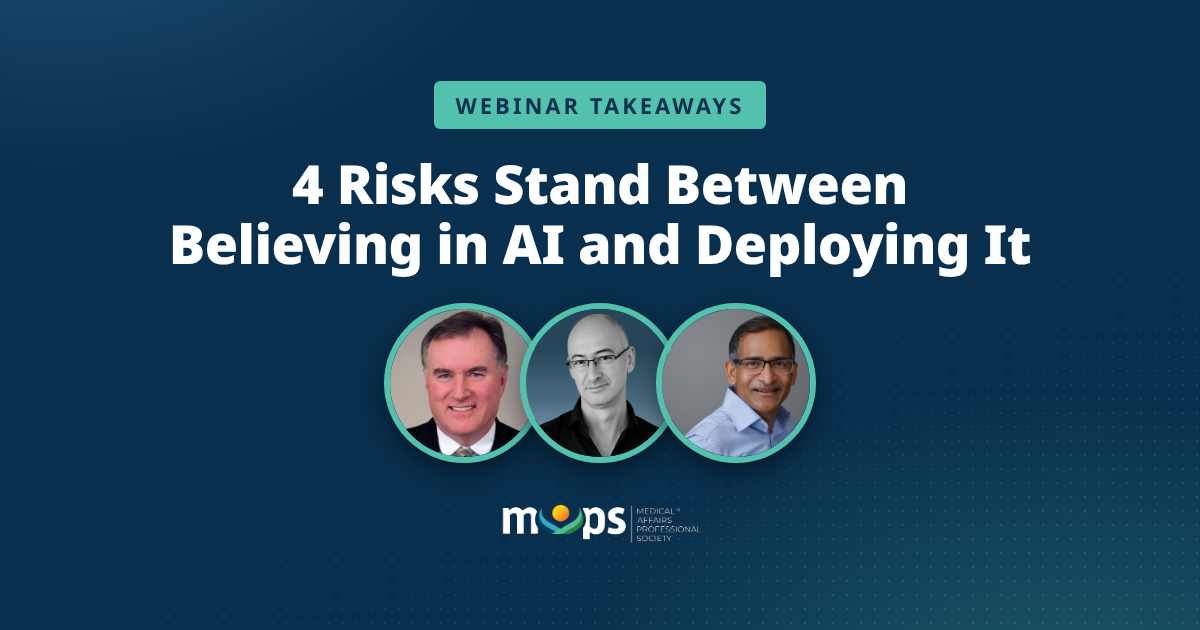
That gap between belief and execution was the reason for the MAPS webinar I moderated in September with Kirk V. Shepard, MD, Chief Medical Officer at PDS Biotechnology and co-founder of MAPS, and Gary Lyons, EVP and Agency Head at Coronado Research and a member of the ISMPP AI Task Force.
We built the session around one observation: AI initiatives in Medical Affairs get stuck between vision and execution because one or more of four risks has not been dealt with.
- Value risk. Is the initiative good enough to produce measurable results that senior management will fund?
- Capability risk. Do you have the skills, tools, and data to execute?
- Trust risk. Will compliance and IT trust the outputs of the process?
- Adoption risk. Will the organization use it once it exists?
When we polled the audience on which risk blocks them most today, trust came out on top and value at the bottom. That is progress. Teams can now identify initiatives that create value. The harder work is governing them.
Takeaways from the MAPS Webinar
1. Hours saved is the wrong number to put in front of leadership
The spring survey showed what Medical Affairs wants from AI: 85% expect time savings, 76% expect more time for strategic work, and 66% expect increased team capacity. Only 38% see it primarily as cost reduction. Gary read this as a bandwidth problem. Teams are overwhelmed by first drafts, literature summaries, and response preparation, and they want that time back.
His follow-up question is the one to sit with: if AI gives your team two hours a day, what becomes of those two hours? Absorbed into more meetings and email, or reinvested in insight generation and strategy? The organizations that gain the most will be the ones that redeploy the time well.
Kirk's answer for the executive committee was specific. Skip hours saved and track the percentage of AI-generated medical insights that result in a documented action: a change in strategy, a guideline update, a new study from an identified evidence gap. Hard to measure, and worth measuring.
2. Ten steps at 90% accuracy is a 35% process
Generative AI is probabilistic by design. It will be wrong sometimes. Take a ten-step process like a publication review or an MIR. If each step runs at 90% accuracy, which is good for today's technology, the end-to-end process lands at roughly 35%. No life sciences organization can accept that. Human oversight has to be designed into the workflow, and that is a capability question, not a tooling one.
The second capability gap is where AI sits. Most AI use in Medical Affairs today happens alongside the work: individuals using chat tools for first drafts or searches, in isolation. Our live poll confirmed it. Only 2% of attendees said they were not using AI at all, but only 10% had AI working inside a workflow in production. Alongside use helps individuals. Inside-the-workflow use changes outcomes for the function. Getting from one to the other takes two skills Medical Affairs teams should build now: AI fluency (knowing what AI can reliably do, and what it cannot) and process redesign.
3. Could you produce the audit trail tomorrow?
Gary's framing of trust was the most practical part of the session. Picture an AI-assisted publication or medical response. An editor asks what exactly AI did and how authors verified it. A regulator asks for the audit trail. An auditor asks who approved it and under which procedure. Compliance asks whether the use aligned with policy. If you can answer all four confidently, you have a defensible process. If you cannot, you have undocumented AI use.
His test for any team: if compliance asked tomorrow for the audit trail behind an AI-assisted content piece, how easily could you produce it?
Governance is what makes speed possible. A workable framework answers four questions up front: what AI is allowed to do (specific approved workflows, not "use AI responsibly"), when a human must be involved, which decisions can never be delegated, and who owns the output. Answer them at the design stage of a pilot, with legal and compliance in the room, and people move quickly because they know the rules.
Regulators are leaning in rather than resisting. Gary pointed to ICMJE's disclosure requirements, the FDA's 2025 draft guidance on a risk-based credibility framework for AI models, and the joint EMA and FDA principles for good AI practice published in 2026. He also described four layers of governance taking shape: accountability (ISO 42001, the EU AI Act), assurance (FDA and EMA principles), integration into professional practice (societies like MAPS and ISMPP), and disclosure (the Vancouver standard, expected at the end of this year).
4. Waiting is the bigger risk
I asked Kirk whether trust concerns justify waiting for guidance to settle. His answer: there will be no moment when a final rulebook arrives. Guidance will keep emerging for years. Each company should find the balance it is comfortable with, watch the outside, and build readiness inside.
Readiness is the gap he sees most often. Even in organizations using AI in several places, use clusters at the edges of the function: writing assistance, meeting prep, document summaries. Core, higher-stakes workflows remain largely untouched. Closing that gap takes visible sponsorship, transparent pilots, and honest conversations about where AI has and has not worked.
One live poll result stood out. In the spring, 20% of survey respondents called their organization leading edge. When Kirk ran the same question with the webinar audience, that number was zero. Six months of real-world use has made the field more honest about where it stands.
5. Start where leverage is high and friction is low
Gary offered a simple way to prioritize: plot each use case by AI leverage (how much measurable lift it can provide) against compliance friction (how much regulatory exposure the workflow carries). Fast wins sit in the high-leverage, low-friction corner: literature search and summarization, internal document drafting, medical information request triage, congress abstract screening. High-leverage, high-friction work such as clinical study report drafting and KOL-facing content comes later, once validated patterns and governance maturity are in place.
Kirk closed with six moves for leaders: identify your fastest wins, measure workflow change rather than tool usage, treat governance as an enabler, think of AI as an assistant rather than a tool and stop fighting it, do not wait for the field to mature, and invest in team readiness alongside technology.
Watch the full conversation
MAPS members can watch the complete webinar on demand in the MAPS Knowledge Center: Closing the Confidence-to-Action Gap: A Practical Path for AI in Medical Affairs. The hour includes the three live polls, Gary's leverage-versus-friction matrix, and the audience Q&A on explainability and external stakeholder trust.
What we are measuring next
Most of this webinar drew on roughly a fifth of the spring survey data. The Fall 2026 round is open now, with the same core questions, so we can see what moved against the spring baseline. Take the Fall 2026 survey. It takes about five minutes. Leave your email at the end and you will receive the full results when they publish.
Six months from now, will your team still be using AI alongside the work, or inside it?