.svg)

Why ungoverned AI tools are filling the gaps your workflow platform left behind.
The quiet workaround
Somewhere in your organization right now, someone is pasting a research proposal into ChatGPT.
This scene plays out daily across life sciences organizations. When workflow platforms don't offer AI capabilities, teams don't simply accept slower timelines. They find workarounds. They paste regulatory content into consumer chatbots. They use personal Copilot accounts to draft summaries. They run sensitive research concepts through tools that sit entirely outside organizational governance.
The work gets done faster. The audit trail disappears.
The compliance gap
Life sciences operate under a fundamental assumption: decisions can be traced, verified, and defended. Regulatory submissions, clinical trial documentation, investigator-initiated study reviews — these processes exist within frameworks designed to ensure accountability at every step.
Shadow AI breaks this assumption quietly. When a coordinator uses ChatGPT to summarize an IIS proposal, there's no record of what the AI produced, no way to trace how extracted data points reached the final form, no visibility into whether the summary accurately represented the source material. If a reviewer makes a decision based on that summary, the decision tree now includes an invisible node.
This isn't a hypothetical risk. It's a structural gap created when regulated workflows meet consumer AI tools.
Visualizing the gap
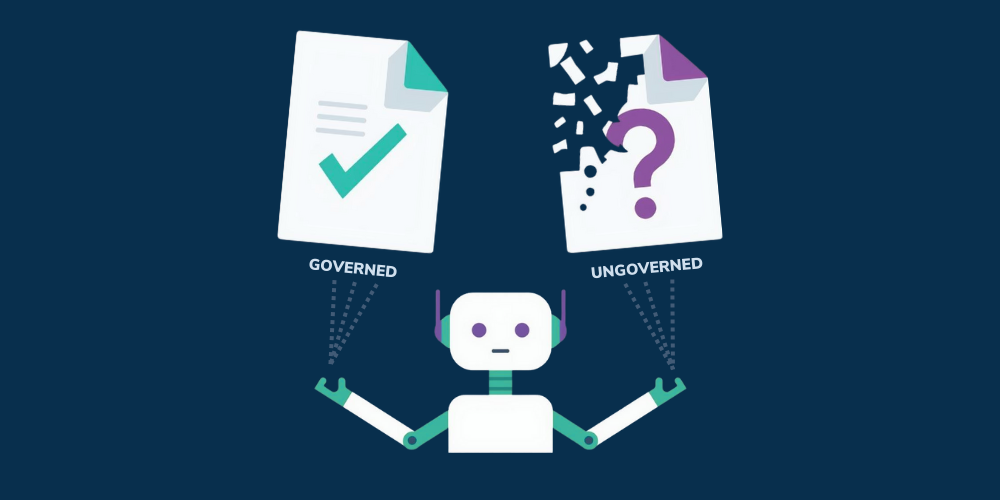
Two paths to AI-assisted processing. Only one maintains compliance.

Why IIS intake is ground zero
Investigator-initiated study programs face a specific version of this pressure. External investigators submit research concept proposals in whatever format works for them — PDFs, Word documents, PowerPoint decks, sometimes all three for a single submission.
Each package needs to be read, understood, and translated into structured data before it can reach a scientific review committee.
The manual process looks something like this:
- A coordinator opens a 45-page proposal.
- They read through sections on study rationale, primary and secondary endpoints, sample size justification, investigator qualifications, institutional resources, budget breakdowns, and projected timelines.
- They extract key details and re-type them into system fields.
- They flag missing information — maybe the IRB approval status is unclear, or the budget doesn't account for patient recruitment costs.
- They route the submission to the appropriate therapeutic area reviewers.
This process repeats for every submission. For organizations receiving dozens or hundreds of IIS concepts annually, the hours compound quickly.
It's exactly the kind of tedious, high-volume work where AI promises immediate relief. And when the official workflow platform doesn't offer that relief, coordinators find their own solutions.
What governed AI actually requires
The appeal of consumer AI tools is obvious: they're fast, accessible, and increasingly capable. The problem isn't the technology itself — it's the context in which it operates.
Governed AI in a regulated environment requires specific architectural decisions that consumer tools weren't designed to provide.
1. Source traceability
When AI generates a summary or extracts a data point, users need to verify that output against the original document. This means more than producing plausible text — it means linking every extracted element back to its source location. If the AI says the proposed study duration is 18 months, a reviewer should be able to click through to the exact page and paragraph where that figure appears.
2. Process visibility
Organizations need to know when AI was used, what it produced, and how that output influenced downstream decisions. This audit trail can't be optional or retroactively constructed. It needs to be built into the workflow from the start.
3. Human oversight
AI acceleration works best when it changes what humans do, not whether humans are involved. Auto-populated fields should surface for coordinator verification. Generated summaries should be reviewed before routing. The goal is to shift human effort from data extraction to data validation — a higher-value activity that still maintains accountability.
4. Data containment
Sensitive research concepts, investigator information, and proprietary study designs shouldn't leave organizational boundaries to reach third-party AI services. The AI capability needs to operate within the same security and compliance perimeter as the rest of the workflow.
These requirements translate existing regulatory expectations into the context of AI-assisted work.
Consumer AI vs. governed AI
A comparison showing the gap between what consumer tools provide and what regulated workflows require.
|
Requirement
|
Consumer AI
|
Governed AI
|
| Source citations | ✘ Not available | ✔︎ Cites original document |
| Audit trail | ✘ No record | ✔︎ Every action logged |
| Human review gates | ✘ User discretion | ✔︎ Built into workflow |
| Data containment | ✘ Data sent externally | ✔︎ Stays within platform |
| Duplicate detection | ✘ No cross-reference | ✔︎ Flags duplicates |
| Compliance flagging | ✘ Generic output | ✔︎ Configured to SOPs |
Designing for governed AI
When we built the research concept triage capability for Approvia IIS, these requirements shaped every design decision.
The citation problem
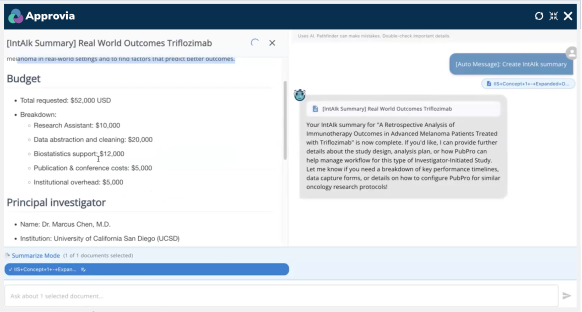
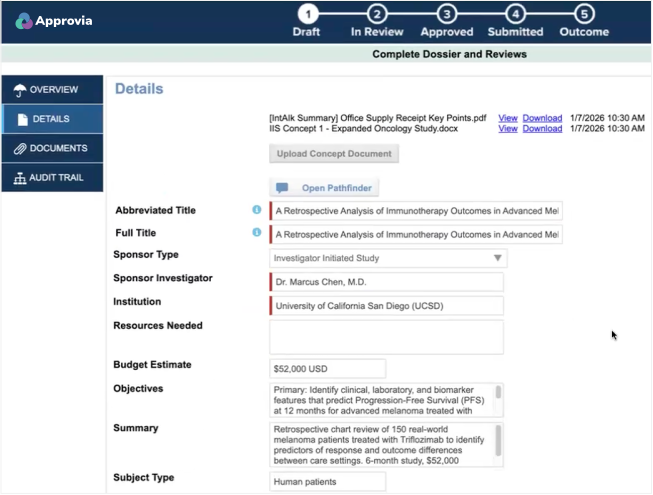
Early in development, we faced a fundamental question: should the AI simply produce a summary, or should it show its work? We chose the latter. Every summary Approvia generates includes source citations that link back to specific locations in the original document. When the system extracts an investigator's institutional affiliation or a study's primary endpoint, reviewers can verify that extraction against the source material.
This decision added complexity to the system. It also addressed one of the core anxieties around AI in regulated environments: the fear that AI-generated content will be trusted without verification. Source citations don't eliminate the need for human judgment — they make human judgment more efficient by eliminating the manual cross-referencing step.
The auto-population question
We debated how much the system should do automatically. Should extracted data flow directly into system fields, or should it surface for coordinator review first? We landed on a middle path: Approvia AI extracts and maps data to fields, but coordinators see what was extracted and can correct errors before the data is committed.
This approach preserves the time savings of automated extraction while maintaining human accountability for data accuracy. It also creates a feedback loop — when coordinators correct AI extractions, those corrections can inform system improvements over time.
The flagging logic
 Not all missing information carries equal weight. A proposal without a clear primary endpoint needs different handling than one missing a secondary contact email.
We built Approvia AI to distinguish between critical gaps (missing IRB status, unclear study duration, absent budget justification) and minor omissions, flagging each appropriately so coordinators and reviewers can prioritize their attention.
The duplicate detection challenge
 IIS programs sometimes receive similar proposals from the same investigator across different therapeutic areas, or variations on previously submitted concepts.
Catching these patterns manually requires institutional memory that may not exist in every coordinator.
Approvia AI scans incoming submissions against historical records, flagging potential duplicates before they consume review committee time.
The broader pattern
IIS intake is one instance of a pattern that recurs across life sciences operations. Wherever teams face high-volume document processing with compliance requirements, the same dynamic emerges: manual processes create pressure, pressure creates workarounds, and workarounds create compliance gaps.

Document-heavyDense documents requiring reading, extraction, and summarization. |
Time pressureVolume and deadlines create pressure to find faster methods. |
|


Medical information teams receiving inquiries that need compliant responses. Regulatory affairs teams processing submission packages. Pharmacovigilance teams triaging adverse event reports. Publication teams managing manuscript workflows. Each domain has its own document types, its own compliance requirements, and its own version of the shadow AI temptation.
The question isn't whether teams will use AI — that decision has already been made, often informally and invisibly. The question is whether organizations will govern that AI use or discover it during an audit.
Where shadow AI shows up
The same pattern repeats across life sciences functions. Different documents, same compliance gaps.

What's at risk? |
The alternative |
|
|
Moving from reactive to proactive
Organizations discovering shadow AI use typically respond reactively: new policies prohibiting external AI tools, additional training on data handling, stricter access controls. These measures address symptoms without solving the underlying problem.
The underlying problem is unmet need. When coordinators paste documents into ChatGPT, they're not rebelling against compliance requirements — they're trying to do their jobs faster. The behavior will persist as long as the need persists. A proactive approach starts with a different question: What would it take to offer AI capabilities that meet both the operational need and the compliance requirement?
This framing shifts the conversation from prohibition to provision. Instead of telling teams they can't use AI, organizations can offer AI that works within governed boundaries. Instead of creating adversarial dynamics between compliance and operations, organizations can align them around shared tools.
The investment required isn't trivial. Building or buying governed AI capabilities takes resources. Training teams to use new tools takes time. Integrating AI into existing workflows takes change management. But the alternative — an expanding gap between how work actually gets done and how it's supposed to get done — carries its own costs, measured in audit findings and compliance remediation.
What to look for in governed AI
Organizations evaluating AI capabilities for regulated workflows should examine several dimensions.
- Integration depth. Does the AI operate within your existing workflow platform, or does it require moving data to external systems? The deeper the integration, the cleaner the audit trail and the lower the data exposure risk.
- Citation architecture. Can AI outputs be traced back to source documents? Look for systems that generate verifiable links, not just plausible summaries.
- Configurability. Can the AI be trained on your organization's specific terminology, document structures, and compliance requirements? Generic AI capabilities may not recognize the difference between a complete and incomplete submission in your context.
- Human review design. Where does the system insert human decision points? Look for thoughtful placement that preserves accountability without recreating the manual bottlenecks AI was meant to solve.
- Audit capabilities. What does the system log? Can you reconstruct how AI-generated outputs influenced downstream decisions? The audit trail should satisfy your most demanding compliance reviewer.
- Roadmap transparency. AI capabilities are evolving rapidly. Understand not just what a platform offers today, but how the vendor approaches capability development and whether customers can influence that direction.
The governance choice
The question facing life sciences organizations isn't whether to adopt AI — adoption is already happening, one ChatGPT session at a time. The question is whether that adoption will be governed or ungoverned, visible or invisible, compliant or risky.
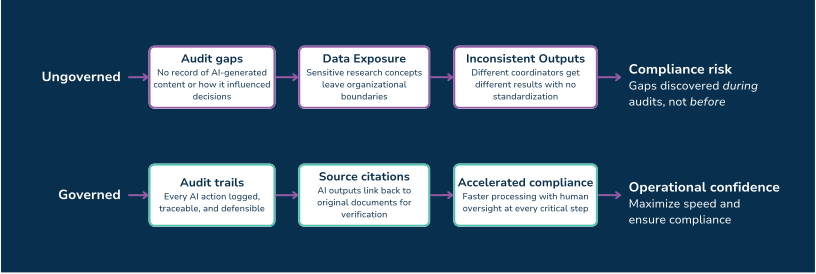
Governed AI in regulated workflows isn't about limiting what teams can do. It's about enabling what they're already trying to do, within boundaries that protect the organization and maintain the traceability that regulatory frameworks require.
For IIS programs, this means coordinators who can process submissions faster without sacrificing audit trail integrity. For Medical Affairs more broadly, it means closing the gap between operational pressure and compliance requirements — a gap that shadow AI fills poorly and governed AI fills well.
The organizations that navigate this transition successfully will be those that recognize AI adoption as an inevitability to be channeled, not a threat to be blocked.
See Approvia in action
Approvia brings governed AI to Medical Affairs teams. From research concept triage to plain language summary generation, Approvia’s capabilities are designed for regulated environments where traceability, human oversight, and compliance aren't optional.
Request a demo to see how Approvia handles your document types and workflow requirements.