.svg)

Drawing on the 2026 AI in Medical Affairs Industry Benchmark Survey and a senior leadership roundtable convened at MAPS Americas 2026.
The confidence that isn't converting
Medical Affairs professionals believe in AI. The data is clear on that. In the 2026 AI in Medical Affairs Industry Benchmark Survey, 86% report being confident or very confident that AI will improve their function's efficiency over the next two to three years. That belief cuts across role, organization size, and seniority.
What's happening with that confidence is harder to read.
Only 20% of respondents describe their organizations as leading edge on AI adoption. The largest group, 41%, identifies as cautious. Another 33% call themselves fast followers, and 6% remain in wait-and-see mode.
When senior Medical Affairs leaders gathered for a roundtable at MAPS Americas 2026 in March and were asked what they were actually doing with AI, the picture that emerged was modest. The work clustered at the edges of the function: writing assistance, document summaries, meeting prep.
That work has value. It is also a long way from transformation.
"What struck me most about this group was honesty. Everyone in that room understood the potential. The harder question, what are you actually doing differently because of it, is where the conversation got real."
— Kirk Shepard, Co-Founder, MAPS; LSAB Member, BP Logix
What "using AI" actually looks like right now
The survey shows where AI has gained a foothold in Medical Affairs. Plain language summaries and literature monitoring tie for the most-deployed use cases, with 44% of respondents reporting each in production. First draft generation follows at 39%, document intake and data extraction at 34%, and medical information response drafting at 33%. These are not pilots anymore.

The roundtable conversation at MAPS Americas 2026 surfaced something the numbers cannot fully capture: how teams are using AI day to day. Microsoft Copilot was the most widely cited tool in the room. At smaller organizations, ChatGPT. These are general-purpose tools designed for individual productivity, opened on demand for whatever task is in front of someone. They're capable, and they're what most teams have access to. They are also different in kind from AI embedded inside the workflow itself. One participant described using AI to prepare briefs before HCP visits. Another talked about quick abstract wordsmithing. A third described using it for brainstorming and document summaries.
The pattern across the room: AI is something people open when they feel like it, not something that runs as part of how work gets done. As Richa Garg, Principal Product Manager at BP Logix, observed of the discussion, "The room is using AI for menial tasks. Core Medical Affairs workflows are still untouched." Clinical study reports, health authority engagement, and other higher-stakes regulatory work remain off-limits even at organizations with AI deployed elsewhere.
That distinction matters. It explains why the same teams that report multiple AI use cases also report that AI has not fundamentally changed how they operate. Faster individual tasks. Same underlying process.
Where the friction is, and what's actually in the way
When the survey asked respondents to rank what is holding their organizations back, validation and accuracy came out on top at 47%, ahead of compliance and regulatory concerns at 43%. That ordering is worth pausing on.
Compliance is real. Medical Affairs operates inside one of the most heavily regulated industries. The data points to a different leading concern: whether AI output is good enough to trust. Teams do not yet have the validation frameworks, internal governance, or confidence in output quality to push AI closer to high-stakes work.
The validation paradox shows up in how teams handle AI output today. 49% of respondents use full manual SME review for every piece of AI-generated content. Only 15% have moved to a hybrid approach combining automated and human review. AI is being used in production. It is not yet trusted enough to streamline the review work it was meant to accelerate.
The roundtable conversation reinforced this picture. AI-generated medical summaries came up several times as a use case people had tried and walked away from. "It was so high-level it was useless," one participant said. Publications surfaced as a particular friction point. "I struggled in publications because there are a lot of external regulations involved, like GPP," another participant noted. The absence of clear FDA guidance came up repeatedly as a significant inhibitor. Without defined guardrails, organizations cannot confidently move into higher-stakes territory.

Validation and accuracy were cited as the top barrier to AI adoption, closely followed by compliance and regulatory concerns.
What teams actually want next
When asked where they want to go next, 38% of respondents named literature monitoring and synthesis as a top future investment area. That is notable because literature monitoring is already the most-deployed AI use case at 44%. Teams want to push further where they have already started. First draft generation follows at 29%, then medical information response drafting at 25%, document intake at 22%, and internal training at 16%.
The MAPS Americas roundtable temperature check confirmed the pattern. Three topics tied for the most attention when participants placed their priority dots on the use cases board: literature monitoring, first draft generation, and internal training. The tie itself tells a story. The field wants to push AI further into production workflows. It also knows its teams are not yet equipped to get there.
Shepard was struck by the range of people gathered: "Different parts of Medical Affairs, different company sizes, all grappling with the same questions. The quality of that discussion reflected where the field actually is: thoughtful, cautious, and ready to move when the conditions are right."

Literature monitoring & synthesis led future interest among survey respondents, followed by first draft generation and med info response drafting.
The workflow integration gap
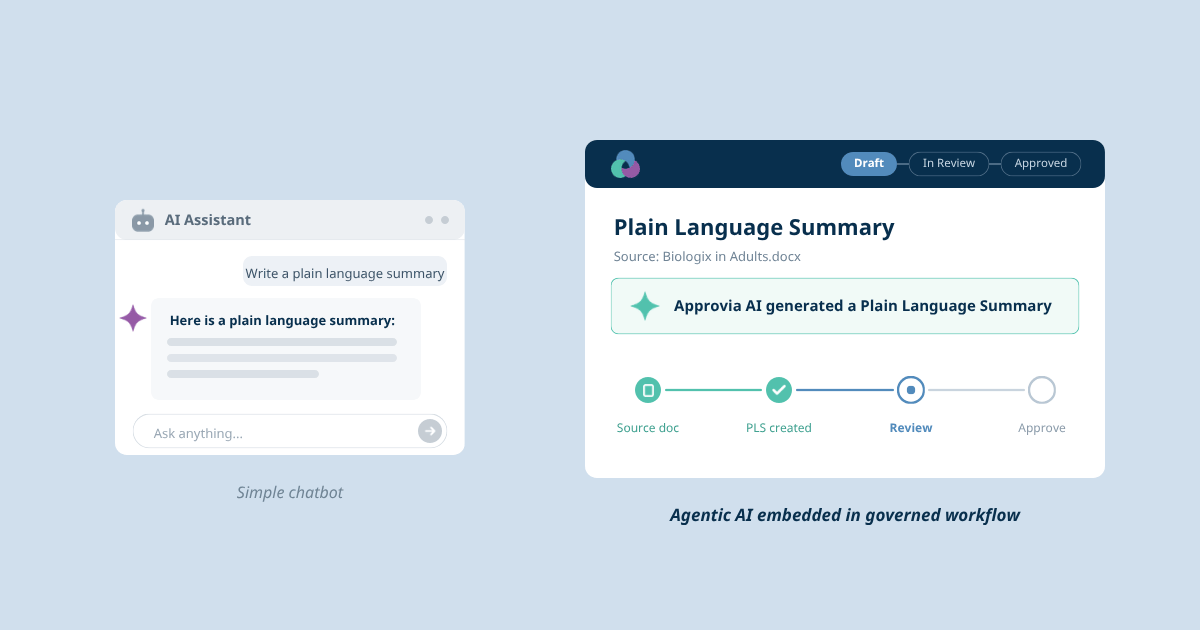
There's a difference between AI as something people invoke and AI as something that runs. Tools that live in a chat window speed up the tasks people put in front of them. AI that runs as a defined step inside a process, with structured inputs and outputs, validation checkpoints, and accountability built in, changes how the work itself gets done.
The two capabilities Garg walked through during the roundtable fit a different model than the Copilot prompts and ChatGPT queries that surfaced earlier in the discussion. The energy in the room shifted noticeably during the demos. Participants leaned in. Questions changed shape, from general curiosity about whether AI was ready for Medical Affairs to specific, practical questions about whether the system could handle this kind of intake or that kind of routing.
What became clear in the room was that for many participants, the demos introduced a category of AI use they hadn't been imagining. The mental model going in was AI as something you open: a chat window, a prompt, an answer. The demos of Approvia showed that AI could run as a step inside a workflow your team has already designed.
Reflecting on the discussion afterward, Shepard observed: "Watching the questions change showed me something specific about where the field is. Most teams haven't seen what AI looks like running inside a workflow. Until they see it, the idea stays abstract. The demos made it concrete in real time."

The document intake demonstration showed how an AI agent can ingest incoming documents, extract structured data, and route it into downstream workflows. Work that has historically been manual data entry happens automatically, with the AI agent surfacing exceptions for human review.
"When you see this running inside a workflow, the conversation shifts from 'is AI ready for Medical Affairs?' to 'which process do we automate first?'"
— Richa Garg, Principal Product Manager, BP Logix
The AI plain language summary demonstration showed the same logic applied to content output. AI drafted accessible summaries from complex scientific literature, with iterative refinement happening inside the publication management workflow itself.

This shift has a measurable consequence. 49% of survey respondents review every AI output by hand. Among teams using AI most heavily, the time saved on creation comes back as time spent on checking. AI that runs inside a workflow, with validation rules built into the process itself, changes that math. The same agent that drafts the output also routes it through the review path the team has already approved. Review effort concentrates on exceptions. The validation logic of the workflow as a whole has already been vetted upfront.
A framework for what to tackle first
For Medical Affairs leaders ready to move past the chatbot stage, the question is where to start. The AI Use Case Prioritization Framework offers a practical filter.
The framework places use cases across two dimensions: AI leverage (the measurable lift AI provides in a workflow) and compliance friction (the workflow's regulatory exposure).

Start at the top-left and work outward. That quadrant pairs high AI leverage with low compliance friction: content-heavy workflows where AI does meaningful work with limited regulatory exposure. The survey shows these are the most-deployed use cases today and the most-named for future investment. From there, the path points rightward, into higher-stakes territory where validation patterns and governance maturity become the prerequisites for expansion.
What Medical Affairs leaders can do now
1. Identify your fastest wins.
Start where the survey data and the framework agree. Literature monitoring and plain language summaries are tied as the most-deployed AI use cases at 44%. First draft generation follows at 39%. These are the same use cases the framework places in the top-left quadrant, which is why the survey shows both broad current adoption and the strongest forward intent. 38% of respondents named literature monitoring as a top future investment area, more than any other use case. The use cases your peers have already validated are the ones that should be on your shortlist.
2. Don't wait for the field to mature around you.
Only 20% of respondents identify as leading edge. 41% are cautious. 33% are fast followers. 6% remain in wait-and-see mode. The cautious majority is the field's current center of gravity, which means moving from cautious to fast follower is itself a meaningful shift in posture. Teams that wait for clearer FDA guidance, more mature tooling, or peer organizations to set the path are betting on conditions that haven't arrived yet. The teams making real progress are starting in lower-friction use cases now and building validation patterns they can extend later.
3. Treat governance as an enabler.
47% of respondents identify validation and accuracy as their top barrier. 49% use full manual SME review for every piece of AI-generated content. Only 15% have moved to a hybrid model that combines automation with human review. The gap between manual review on every output and a defensible hybrid approach is fundamentally about governance. Roundtable participants pointed to internal AI governance documents as one of the more practical enablers of forward movement: a written framework that defines what AI is allowed to do, what gets escalated, and what stays in human hands gives teams permission to deploy with confidence.
4. Measure workflow change, not tool usage.
Tool usage is rising. Workflow change is not, at least not yet. 44% of respondents have AI deployed for plain language summaries. The most-cited tool across the roundtable was Microsoft Copilot. Those facts together describe a field that has put AI inside the function without changing how the function operates. The honest measurement question is not "how many people are using AI?" It is "which workflows look different than they did 12 months ago?" Most teams, including ones with multiple use cases in production, would struggle to name three.
5. Invest in team readiness alongside technology.
Internal training tied for the top spot in the roundtable's future-priority vote, alongside literature monitoring and first draft generation. 24% of survey respondents cite lack of expertise as a top barrier. 15% describe their validation approach as "still figuring it out." Across all three signals, the pattern is the same: capability is more available than know-how. The teams making real progress are investing in critical evaluation skills, prompt and review judgment, and internal advocacy alongside the technology itself.
"The companies we see getting real results from AI in Medical Affairs share a discipline. They have been intentional about where AI touches the workflow and what it is accountable for delivering. Budget and tooling matter less than that intentionality."
— Girish Pashilkar, CEO, BP Logix
Where AI in Medical Affairs is heading
The trajectory of AI in Medical Affairs is less about technology maturing than about a category becoming visible. The teams positioned for what comes next are the ones that can see workflow-integrated AI as a current option and act on it now: building governance, validation patterns, and internal capability while the rest of the field is still imagining AI as something you open.
When clearer guidance arrives, when more vendors offer mature workflow-integrated AI, and when peer organizations begin to publish results, the leading-edge group will scale what is already working. The cautious majority will follow. The teams that started early will be the ones with the playbooks.
"What I kept hearing during the roundtable was a genuine readiness to figure out how to use AI efficiently and responsibly. Skepticism was not the issue. The field needs clearer frameworks for doing this well."
— Kirk Shepard, Co-Founder, MAPS
Explore the survey results
View the full 2026 AI in Medical Affairs Industry Benchmark Survey dashboard for the complete picture on AI adoption, use cases, blockers, and validation approaches across the field.
An abridged version of this article is also available in MAPS Innovate.